





2026 – February Report
Plenty of kiwi tucker
Plenty of kiwi tucker
Kiwi are doing well after the wet January and warm but not scorching February. The summer rain has led to a healthy boost in the invertebrate populations, particularly crickets, slugs and cicadas – all good kiwi tucker.
The kiwi dads in the Heads/Parua Bay area have had another successful round of nesting producing more chicks for the season. Spare a thought for the patient, hungry dads nesting for two bursts of 90 days plus this season – that is 6 months of nesting with only a few hours a night off the nest to feed. Their freshly hatched chicks now have a good supply of food to get them off to a good start in their slow growth to adulthood and the dads will be hard out feeding to put weight back on. This time last year the adults were struggling in the drought conditions and chick survival was down. The summer rain has made a huge difference this year.
Purua Operation Nest Chick (ONC) dads, Matakohe Island crèche and kiwi release
ONC dads in Purua are the kiwi that we get chicks from to take to Matakohe/Limestone Island to grow up for Kiwi Coast releases. We are very grateful to Ngati Hine, DoC and the farmers of Purua for the gift of these chicks and to FOMLI and Te Parawhau for protecting the chicks on the island while they grow. We have transferred 8 chicks this season from the first round of nesting but unlike their coastal cousins the ONC dads are having a cruisy summer and have not nested again (maybe the coastal pampas nest burrows stayed drier than the dirt burrows at Purua?).
Using thermal scopes at night Bevan, Rolf and I caught up with some of the previous seasons’ chicks on the island that have now grown to over 1200g. We transmitted them in preparation for their release next month at Piroa. Thanks to Tamra’s organisation and all those consulted to approve the variation of our release permit to allow this to happen. The community led Piroa Conservation Trust has worked hard on kiwi recovery and other work in the area so these kiwi are going to a good home to add to the population there. The release and follow up radio transmitter monitoring of these kiwi will help further engage the community with their kiwi and lead to even more support for kiwi saver/1080 pulses to control trapshy stoats and ongoing dog control to protect adult kiwi.
Annual Kiwi Count coming up May 5- May 23
To monitor the effectiveness of our kiwi recovery work we count kiwi each year at 19 listening stations throughout the Heads. If you are one of the skilled and dedicated kiwi counters who do this work please note the dates. Jess and I will be in touch closer to the time. Thank you in advance!! The official counting window is early this season but that is probably a good thing if kiwi feeding conditions continue to be good – well fed kiwi have more drive to breed and start calling harder!
Backyard Kiwi monitored kiwi update for February 2026
Whangarei Heads/Parua Bay Radio monitored kiwi:–
- Chookie– His transmitter has definitely failed – as confirmed by trail cam video of him still wearing it but no signal. He should have finished nesting by now so we have been listening out in case the change in mode (from nesting pulse to normal pulse) on the software in his transmitter sparks up transmission again –but no luck!
- Teina– In his usual valley of pampas and pines at the northwestern end of Martins’ pine block. 9.5 hours of activity.
- Beach Girl – In the pampas at the northwestern end of Martins’ pine block. 9.5 hours activity.
- Murdoch –10 hours nightly activity. Feeding up after nesting. He is in a big area of pampas in a harvested area of pines at the end of Ross Road.
- Humphries – Nesting – 87 days in on 9/2/26. His datastream showed that his activity was rising and nesting was finishing so I checked his pampas nest. He had a single healthy chick- 270g, 46.9mm bill length, and ID chipped (see pics). Whangarei Heads School are naming him. Dad was down to 1600g and in Poor condition after his nesting stint. North-eastern end of Martins’ pine block.
- Wally –He has moved down to the wetland on the estuary edge to feed up after his successful nesting. 10 hours nightly activity. The pines in his territory are being harvested at present; the landowner and logging contractor have been working hard to minimise the risk to the kiwi there. I have been visiting regularly and Wally is keeping his distance from the logging at this stage. His ID chipped chicks from his two successful nests have been named “Globbitts” by Campbell road Landcare, “Little Phoenix” by Backyard Kiwi proud supporter Master Boon and “Lomafay” by new proud BYK supporters Sue and Wayne Morris in recognition of their valued support.
 Humphries after hatching chick
 Humphries new chick
 Humphries new chick
Kiwi that have walked to other areas:
- Whareora Landcare area/NRC pines: Te Motu Manu Hine– She has a steady 10 hours of nightly activity. She has remained in her territory of pampas and pines in the NRC block behind the Money Factory.
- Tamaterau/Waikaraka: Kim– She is still in the valley up behind Waikaraka but is moving around a bit more within the valley. She is possibly dropping down to the damper areas in the valley as it dries up again. – 10.5 hours activity.
- Whanui Pine Block:Ping – She is still in the Whanui Pine Block. 10 hours activity.
Purua ONC dads
Rua’s second round nest failed and no others look to be having a go at a second nest at this stage. The dads are starting to cuddle up with their mates so we may get an early start to the next breeding season. 8 chicks transferred to date for this season :
- Buddha – In the paddock north of McGraths’ quarry, 10 hours of nightly activity.
- Macio – South Purua reserve. 10 hours of activity.
- 64 – Usual area SW Purua Reserve. 10 hours of activity.
- Tahi– Tucked into a stoney gut on the eastern face of Purua. 10 hours nightly activity.
- Sam – SW Purua reserve. 10.5 hours of activity.
- Derek – 9 hours nightly activity, usual area SE Purua reserve.
- Fletcher – In his usual area behind the Lovells’ airstrip. 10 hours activity.
- Rua – Back of Alisons’ farm. His second nest failed after approx 25 days, activity now up to 9.5 hours per night.
- Erima – In native stand in the paddock on Hawkins’ hill. Found him in one of “old fella’s” old burrows with female ID chip 80ef8do, who I first found with “Mitch” back in 21/10/22 – this was before Mitch’s disappearance. Her bill has grown from 130mm to 139.5mm and she was 2500g and in moderate body condition. Erima was 1850g and in poor-mod condition – did his transmitter band change. 9 hours activity (see pics).
- Prime – Near the top of Hawkins’ hill. In the burrow we first found him in back on 1/5/25. 2000g, Mod condition did his tx band change, 9 hours nightly activity (see pic).
- Purua– signal from Lovell’s side of Purua reserve. 10 hours of activity.
 Adult female with Erima
 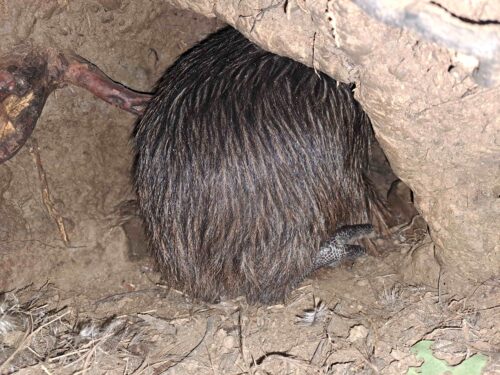 Erima
Erima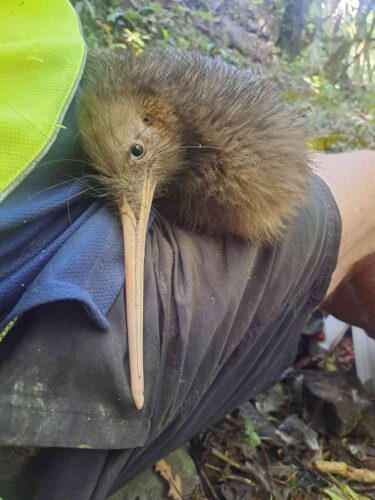 Prime
Prime
Trapping/ toxin pulses
February catches: Stoats 3, weasels 6, cats 0, rats 89, hedgehogs 14 and possums 4. Planning for kiwi saver pulses underway.
Cheers Todd
Todd Hamilton
Backyard Kiwi Project Manager
Whangarei Heads Landcare Forum