





2026 – June Report
2025-2026 Season
Whangarei Heads Landcare Forum AGM
Thanks to all those that attended the WHLF AGM. It was a good turnout with good representation from many of the groups and projects doing good work in the wider Whangarei Heads area. Thanks to our hard working WHLF committee for all their work – in particular Helen Moodie as Chair, Carol Martin as Secretary and Audrey Rhodes as Treasurer. After the AGM there was a lengthy session of updates from the local groups – it took a while because there is so much good stuff going on! This is an amazing community doing amazing work to look after our backyard.
2025-2026 Season Backyard Kiwi trap catch data
In unmanaged areas of New Zealand 95% of kiwi chicks are predated in their first 6 months of life, mainly by stoats. Stoat control at the Whangarei Heads has dramatically improved the survival rate of the kiwi chicks here. Since 2002 we have been operating a kiwi predator trapping network over an approximate 8000ha area. We have just finished our trapping season (and started the next!). Our tallies for the July 2025- June 2026 season are:
- 16 Stoats caught is the third lowest tally, the annual average is 24 stoats. This is probably a result of the effectiveness of the targeted, bait station based, Kiwi Saver/1080 pulses undertaken this season (see details below). The Whangarei Predator Free (WPF) trail camera network reinforces this with low stoat numbers detected in the Whangarei Heads area.
- 92 Weasels is a record high catch by a significant margin, and this is also probably a reflection of the low stoat numbers (as stoats predate on weasels). The long term weasel catch average is 28 per year. Back in 2002 the Stoat:Weasel catch ratio was less than 1:1 (55:46), it is now over 1:5 (16:92). Weasels also have a much smaller home range meaning a higher density of traps/baitstations is needed for their control. Weasels are not a threat to kiwi.
- 9 Cats is a record low but the trapping effort has reduced. Long term average of 23 cats. Even so, it is likely that there is better cat owner control and anecdotally there is less dumping of cats in the area, but it is very difficult to read much into this.
- 1,022 Rat total (includes 39 Norway rats) is another high rat catch, following the upward trend over the past 24 years. Initial catch was 391 in 2002, with a long term average of 569.
- 95 Hedgehogs is a significant increase after the recent years of low catches, but still well off the peak of 149 in 2014. In theory they are very hard to control by trapping. Environmental conditions such as floods and droughts may be having an impact on hedgehog populations. Maybe even competition from kiwi? This summer/autumn there were good feeding conditions for both hedgehogs and kiwi.
- 58 Possums. These are a bycatch as possums are not specifically targeted by the predator trap network. There is still a scattering of possums throughout the area despite intensive control programs.
It is important to note that it does not matter how good a predator trapping network is – over time it becomes less effective due to trap/lure shy stoats. To clear these trap/lure shy stoats out of the area we use a controlled pulse of toxin in bait stations that kills the stoats by secondary poisoning via rats. ‘Kiwi Saver’ (1080) is the best toxin for this purpose. It is a crucial component of stoat control in any landscape area and is particularly effective on a peninsula like the Heads. Kiwi Saver/1080 is able to be used due to the trust BYK has built up in the community.
The ongoing combination of an extensive trapping network and controlled secondary toxin pulses continue to ensure good kiwi chick survival in our area.
Ferrets can kill adult kiwi. No ferrets were caught in our trapping area this year but several were caught in the wider Whangarei area so we continue to use traps capable of catching ferrets as they would have a devastating impact on the kiwi population.
As uncontrolled dogs remain the biggest threat to adult kiwi without good dog control by the majority of dog owners at the Heads all this pest control for kiwi would be wasted!
Annual Kiwi Count finishing up
It is not just about counting trap catches but more importantly counting the kiwi themselves to see if the stoat control and good dog control is working. Thanks to the team of keen kiwi counters working away at our annual kiwi count at 19 sites throughout the Heads. The final data is coming in now, we will have a summary for you next month.
Backyard Kiwi Annual Report for 2025-2026 year
If you would like to see more details of the Backyard Kiwi work carried out over the past year, detailed trap catches, outcome monitoring, community engagement etc the Annual Report is attached here.
What your kiwi are up to:
Recently released kiwi: – all doing well
- Owhi – After last month heading north to Ross Road she continued walking to end up 6km north at the end of Telfer Road. Since then she has looped around and returned to the Rukawai valley just north of where we released her. 12.5 hours average nightly activity (see pic).
- Tumanako – After steadily working his way south through the pines and pampas on his Owhiwa Road release block he spent time in an adjacent pine block that is being logged. Since then he has bounced over to Kohinui valley before returning to the block being logged and at the moment has wisely returned to the release block. 11 hours nightly activity with a one night drop to 9 hours for some reason.
- Flaxy – She has headed to the south-eastern corner of the Owhiwa Road pine block- plenty of kiwi heard calling in that area lately. 12.5 hours average nightly activity.
- Kua tae – After his release in May (via Whangarei Heads School) he hasn’t moved far from his release site at Owhiwa road. 12.5 hours nightly activity.
 Owhi before release (April)
Whangarei Heads/Parua Bay Radio monitored kiwi:–
The dads have started nesting- three patient, hungry months ahead of them (see pic):
- Teina– In his usual valley of pampas and pines at the northwestern end of Martins’ pine block. No sign of nesting. 12.5 hours of activity.
- Beach Girl – In the pampas on Halses’ cut over pine block at Ross road. 12.5 hours activity.
- Murdoch –His activity is dropping – so he looks to have started nesting in a pile of pine slash and stumps in the logged area of Halses’ block at Ross Road (see pic).
- Humphries – North-eastern end of Martins’ pine block. 6 days nesting on 26/6/26. 4.5 hours nightly activity.
- Wally –Nesting 4 days on 26/6/26 in his usual area of pampas/pines/gum trees at Campbell road. 6.5 hours nightly activity.
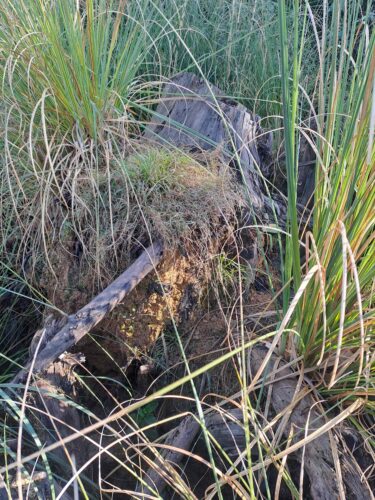 Murdoch’s nest in pine slash and pampas
Kiwi that have walked to other areas:
- Whareora Landcare area/NRC pines: Te Motu Manu Hine – She is still in the NRC pine block behind the money factory but slightly north of her usual area. 12.5 hours of nightly activity.
- Tamaterau/Waikaraka: Kim – after her return from her big walk to Waikaraka she has stayed close to her March 2025 release site. She must prefer her old kiwi mates to any at Waikaraka. A busy 13 hours nightly activity.
- Whanui Pine Block: Ping – Carl monitoring – she is still in a similar spot in the Whanui pine Block.
Purua ONC dads
Nesting is getting underway here too:
- Buddha – In the paddock north of McGraths’ quarry, his burrow looks nesty (lots of vegetation pulled into its entrance) and down to 7 hours activity (see pic).
- Macio – South Purua reserve. 10.5 hours of activity.
- 64 – Usual area SW Purua Reserve. 10.5 hours of activity.
- Tahi– Back of Alisons’ farm. 12.5 hours nightly activity.
- Sam – In scrub in Hawkins’ paddock SW of reserve. 11 hours of activity.
- Derek – Usual area on the south face of stump ridge SE Purua reserve. Activity 12.5 hours.
- Fletcher – Usual area above the airstrip. Down to 8 hours of activity on the day checked so hopefully starting to nest.
- Rua – Back of Alisons’ farm. Activity down to 6.5 hours so he should be starting to nest.
- Erima – In native in the paddock on Hawkins’ hill. 12 hours activity.
- Prime – Near the top of Hawkins’ hill. 9 hours nightly activity. Maybe starting to nest.
- Purua– On the face behind Lovells’ Irving road woolshed. 11.5 hours of average activity but down to 8 hours one night so hopefully he is starting to nest.
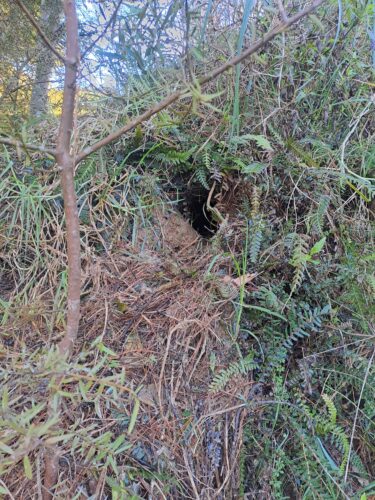 Buddha’s nest in paddock
Cheers Todd
Todd Hamilton
Backyard Kiwi Project Manager
Whangarei Heads Landcare Forum